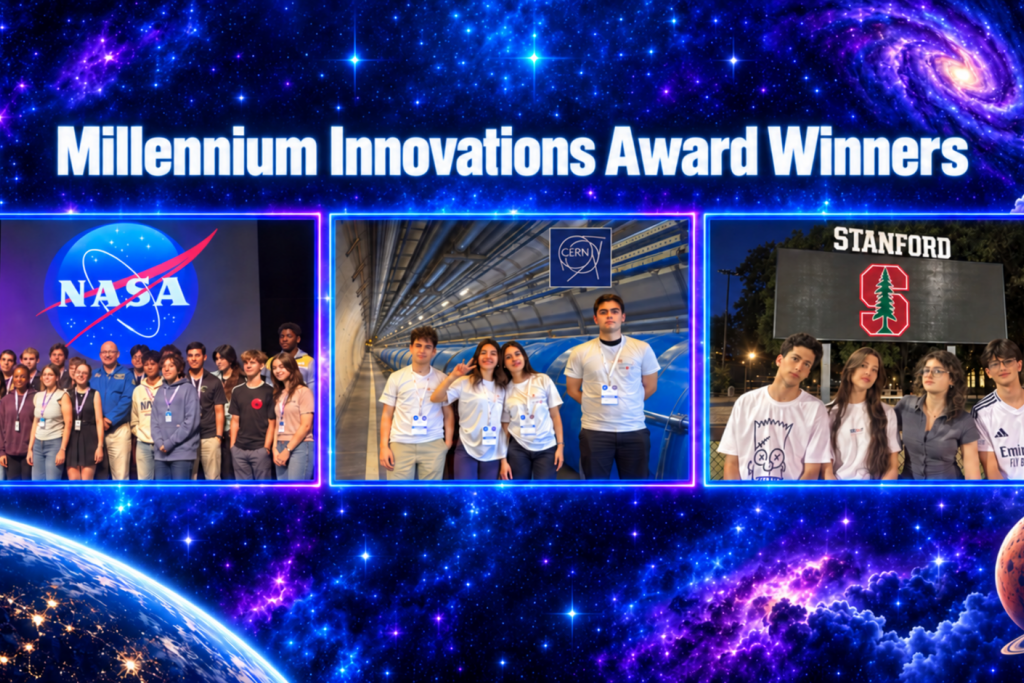
The winners of the 2025 Millennium Innovations Award participated in international educational programs in the United States and Switzerland. Members of the three winning teams explored NASA space program simulations, expanded their technological expertise at the Stanford University campus, and studied leading scientific experiments at CERN.
Participation in international programs serves as a prize of the Award, providing young people with the opportunity to develop their interests in real-world scientific and technological environments, work on hands-on projects, and gain deeper insight into education and career opportunities in STEM fields.
Mars Mission at the NASA Space Center
The first-place team, "Clusters," participated in the "Martian Expedition" program run by Space Center University at the Houston Space Center in the USA.
Space Center Houston’s educational programs at NASA’s Johnson Space Center are inspired by real space research and missions, offering young people hands-on opportunities to study science, engineering, and technology. The "Martian Expedition" is specifically designed for 15-to-18-year-olds and focuses on engineering challenges related to Mars exploration.
As part of the program, the Georgian students:
The program placed special emphasis on hands-on learning, experimentation, teamwork, problem-solving, and decision-making in challenging environments. This experience showed students how a scientific idea can transform into a technological solution and how knowledge can serve as a tool to solve real-world problems.
Technology Training on the Stanford Campus
Supported by the Georgia's Innovation and Technology Agency (GITA), the second-place team, "Armo," attended the iD Tech Summer Camp on the Stanford University campus in the United States.
iD Tech is an international technology education program for children and teens that introduces young participants to programming, artificial intelligence, robotics, game design, and digital design. The summer camp takes place on the campus of Stanford, one of the world's leading technological universities, combining tech education with an introduction to the university environment.
During the program, students deepened their knowledge in programming, computer science, artificial intelligence, data analysis, engineering, robotics, game development, and 3D modeling.
They also had the opportunity to explore Stanford's campus life and the innovative ecosystem of Silicon Valley, collaborate with international peers, and engage in team educational activities. The program not only provided students with new technical skills but also demonstrated how to develop an idea, build a prototype, and turn a technological solution into a real product.
Scientific Journey to Switzerland
Supported by Liberty Bank, the third-place team, "Risk Trackers," went on an educational visit to Switzerland. The itinerary included visits to CERN (European Organization for Nuclear Research), the University of Geneva, the Swiss Science Center Technorama, and the United Nations Office at Geneva.
CERN is one of the world's premier scientific research centers, where scientists study the fundamental structure of matter and the origins of the universe. The organization places special emphasis on making science education accessible to students and teachers.
At CERN, the Georgian students participated in a laboratory workshop and learned about two major experiments at the Large Hadron Collider: ALICE and CMS. Through ALICE, scientists study the conditions of the early universe, while CMS represents one of CERN's largest international scientific collaborations, involving scientists and engineers from dozens of countries around the world.
At the University of Geneva, practical workshops were held for the students on artificial intelligence, programming, astronomy, and biophotonics. The university visit introduced the young participants to a modern research environment and international academic career opportunities.
At Technorama, participants explored science through interactive experiments. As Switzerland's largest science center, Technorama allows visitors to directly experience natural phenomena and technological processes, aiming to spark curiosity in science and technology through experimental learning.
During their visit to the United Nations Office at Geneva, students learned about the inner workings of international organizations, the importance of multilateral cooperation, and the crucial role science and technology play in addressing global challenges.
About the Award
The Millennium Innovations Award is designed for students aged 13–17. Participants create innovative projects in space and aviation, robotics, mobile technologies, environmental protection, healthcare, energy, and transportation.
In 2025, 101 teams comprising 337 students from all regions of Georgia participated in the Award:
Participating in these international programs allowed the winners to apply classroom knowledge in practice, work with modern technologies, and experience world-leading scientific and educational environments firsthand.
The new knowledge, international connections, and hands-on experience have further boosted the motivation of these young people to pursue their future education and professional careers in science, technology, engineering, and innovation.
For detailed information about the Award, visit: https://millennium.org.ge/geo/projects/mia/9